Catalogue ownership remains the ultimate long-term music asset
Learn why major labels are spending billions on publishing rights, and how independent artists can protect their catalog value now.
Key Takeaways
Publishing rights are being bought as long-term equity assets, not short-term revenue streams.
Retaining both master and publishing ownership gives you control over sync licensing and catalog value appreciation.
Register as a songwriter with your performing rights organisation before anyone else claims your composition ownership.
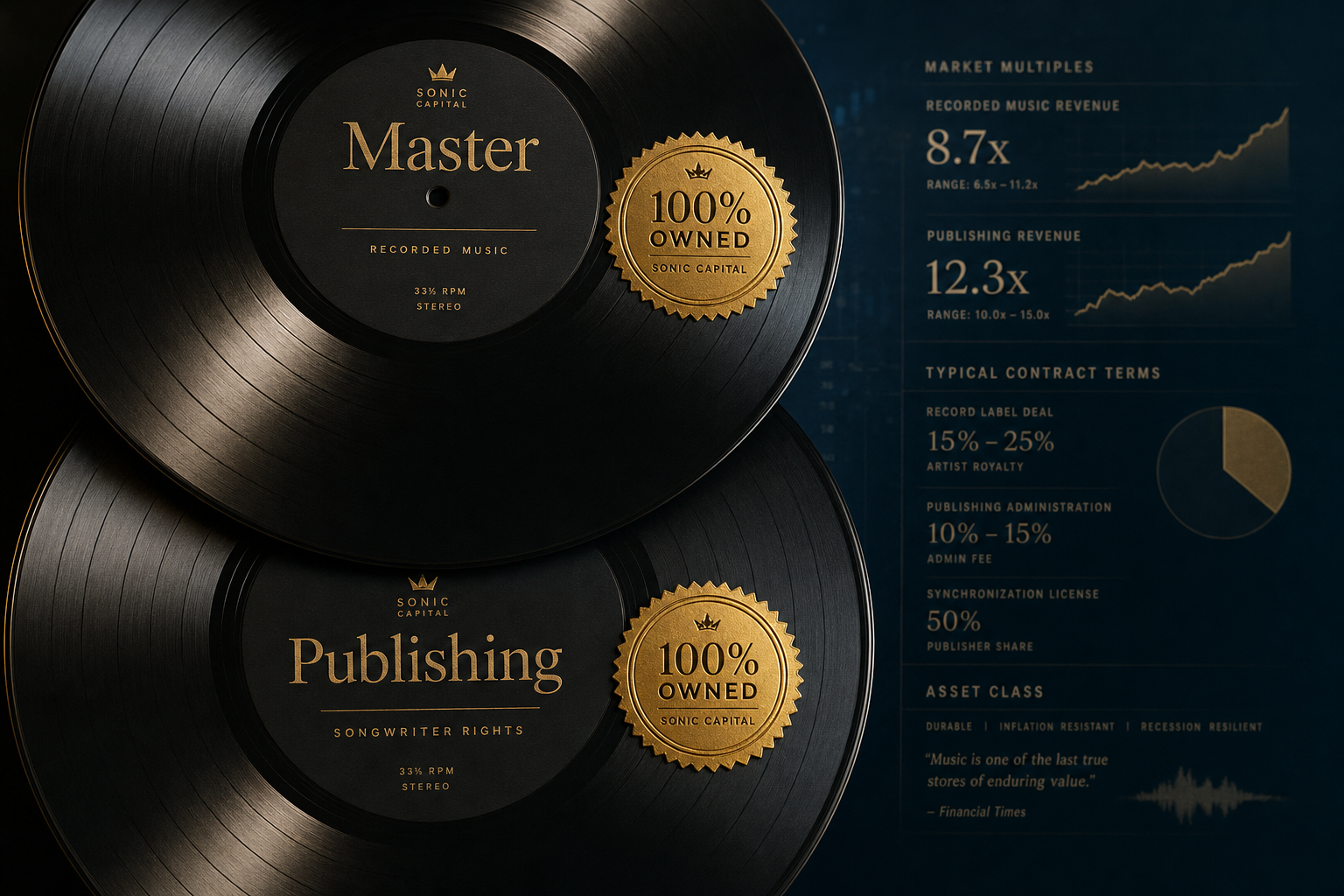
Your annual publishing revenue multiplied by 8 to 12 equals your approximate catalog valuation for wealth building.
Sony Music Publishing just spent $4 billion buying 45,000 publishing works from Recognition Music Group. This wasn't about getting more songs to license. It was about owning the rights to future revenue forever. While the majors consolidate catalogues as long-term equity, most independent artists are still focused on streaming payouts that build someone else's wealth, not their own.
Sony Music Publishing just spent $4 billion acquiring 45,000 publishing works from Blackstone's Recognition Music Group. The catalog includes compositions by Beyoncé, Lady Gaga, and Journey. This isn't about adding songs to a playlist. It's about owning the infrastructure that generates wealth for decades.
Why major firms are buying catalogs instead of breaking new artists
Catalog M&A hit an all-time high in 2025-2026. The majors are treating publishing rights as long-term equity, not short-term licensing revenue. While independent artists chase DSP payouts, the majors are accumulating ownership. The implication is clear: streaming payouts subsidize future profits for catalog owners. Ownership is the real wealth builder.
This shift matters because it exposes the fundamental disconnect in how most independent artists think about their music. You're focused on this month's Spotify numbers. They're focused on buying your publishing 10 years from now at 8x annual revenue.
Master rights vs. publishing rights: The distinction that determines your net worth
Most artists confuse these two ownership categories. Here's the breakdown:
Master rights control the actual recording. The audio file. The specific performance captured in the studio. When someone streams your song on Spotify, the master owner gets paid.
Publishing rights control the underlying composition. The melody, lyrics, and structure. When someone covers your song, uses it in a film, or performs it live, the publishing owner gets paid.
The majors are prioritizing publishing acquisitions right now because publishing rights generate revenue across more use cases. A single composition can earn from the original recording, cover versions, sync placements, live performances, and samples. Publishing is a multiplier.
If you own both masters and publishing, you control sync licensing opportunities, revenue from covers, and long-term catalog value appreciation. You're not just an artist. You're a rights holder with compounding assets.
The reality check: What's actually achievable in your first five years
Honest truth: Most independent artists will never own 100% of both masters and publishing in their first five years. Co-writes split publishing. Producers take points. Sample clearances carve out percentages. This is normal.
What's realistic: Retaining master ownership through distribution is now standard. Protecting publishing rights requires more discipline and awareness.
Who this applies to: Artists with one or more songs generating consistent revenue or demonstrating cultural staying power. If you're pre-revenue or pre-audience, focus on creation and distribution first. Ownership protection becomes critical once you have something worth owning.
Five actions to protect and build catalog value starting today
1. audit your existing deals
Pull every publishing agreement, sync license, and distribution contract you've ever signed. Write down three things for each: Who owns the masters? Who owns the publishing? For how long? If you don't know the answer, you don't control the asset.
2. choose your distribution partner deliberately
Use DIY distributors like CD Baby, RouteNote, or Ditto that guarantee you keep 100% of master rights. Avoid aggregators that take a backend equity stake or require exclusive rights in perpetuity. Read the fine print on reversion clauses. If the contract doesn't specify when rights revert to you, assume they don't.
3. register your publishing immediately
Register as a songwriter with your performing rights organization. In the US, that's ASCAP, BMI, or SESAC. In other territories, find your local PRO. Claim your composition ownership before anyone else does. Unregistered works are vulnerable to third-party claims and administrative captures.
4. set a retention floor
Decide now: What will you never sell, license exclusively, or hand over? Draw that line before you're desperate for money. Write it down. Make it non-negotiable. This prevents bad decisions during cash flow emergencies.
5. monitor catalog valuations
Track public deals like the Sony-Recognition acquisition. Use simple multiplier math to estimate your catalog's value: Your annual publishing revenue × 8 to 12 = approximate catalog valuation. If your publishing generates $10,000 annually, your catalog is worth $80,000 to $120,000 in a sale scenario. This number is your north star for long-term wealth planning.
You're not racing for streams. you're building a vault.
Every decision to retain or outsource ownership is a decision about whether you're building company equity or renting access. The next decade of your career depends less on this quarter's playlist placement and more on whether you own what you build.
The majors understand this. That's why they're spending billions on catalogs while independent artists celebrate 100,000 streams. Streams are cash flow. Ownership is wealth.
You are not a content creator on someone else's platform. You are the CEO of a creative enterprise. Start acting like one.
Track the latest catalog acquisitions to stay informed on market valuations.
Get the independent artist contracts checklist: A breakdown of which rights to fight for, and which to license strategically.
Further Reading:
- Sony Music Publishing Officially Acquires Recognition Catalog — Digital Music News — https://www.digitalmusicnews.com/2026/05/11/sony-music-publishing-recognition-music-catalog/
- From Sony Music Publishing's $4 billion catalog deal to Live Nation's Blue Dot fever rebuttal — Music Business Worldwide — https://www.musicbusinessworldwide.com/from-sony-music-publishings-4-billion-catalog-deal-to-live-nations-blue-dot-fever-rebuttal-its-mbws-weekly-round-up/
- Music Catalog Acquisitions 2026: Live Tracker + Analysis — Chartlex — https://www.chartlex.com/blog/business/music-catalog-acquisitions-tracker-2026
Ready to streamline your workflow?
Stop piecing together spreadsheets and scattered notes. Join the waitlist for Music Artist Manager and get your entire rollout in one place.
Written By
Gavin Alexander
Senior Marketeer
As the founder of Music Artist Manager, Gavin has spent years at the intersection of music and technology. Seeing firsthand how chaotic release rollouts and split sheets can be, he designed a platform that brings major-label infrastructure to independent artists and their teams. He writes extensively about industry trends, artist leverage, and workflow optimisation.