Spotify's 1,000-stream threshold: How to build revenue on owned channels
Spotify's 1,000-stream threshold is pushing independent artists out of streaming income. Here's how to build revenue on owned channels instead.
Key Takeaways
Spotify's 1,000-stream threshold is policy architecture, not a technical fix or accounting adjustment.
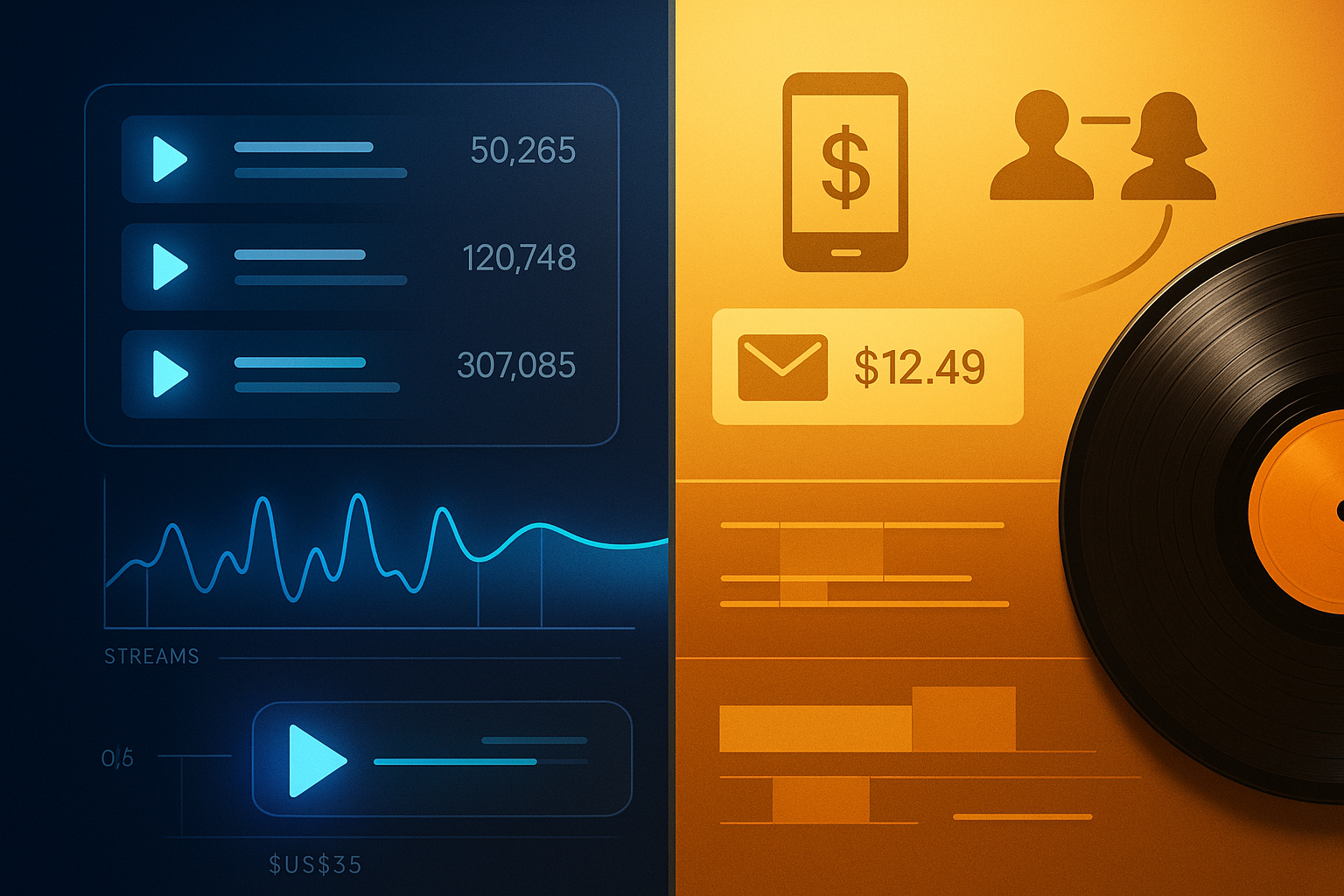
A single £8 Bandcamp sale equals 2,200 Spotify streams in revenue.
Streaming is now a discovery funnel, not your primary income source.
The long tail is being deliberately hollowed out by threshold economics and artist-centric models.
Spotify's 1,000-stream annual minimum isn't a tweak to the royalty system. It's the deliberate construction of a two-tier music economy, and it's already pushing independent artists off streaming as a viable income source. Here's what that means for your catalog, your revenue strategy, and where you should actually be selling your music in 2026.
The streaming bifurcation: why the 1,000-stream threshold is reshaping independent music
Spotify introduced the 1,000-stream annual minimum in 2024. Today, approximately 45 million tracks on Spotify generate zero streams. Deezer followed with an artist-centric model that deprioritizes songs below 1,000 plays per month from 500+ unique listeners. This is not a glitch. It is the deliberate architecture of streaming's future.
The structural shift no one is naming
The music industry is bifurcating into two parallel economies. Streaming platforms are building a two-tier system: mainstream consumption (algorithmic playlists, high-volume releases, major label partnerships) on one side, and fan-driven creation (direct sales, memberships, owned channels) on the other.
This is not evolution. It is deliberate segmentation.
When Spotify and Deezer implement threshold economics, they signal a fundamental shift in power. Streaming is now a discovery channel with vanishing payouts, not a primary income source. The real margin lives elsewhere: owned channels, direct-to-fan sales, and superfan platforms.
What you need to understand about pro-rata economics
Streaming payouts operate on pro-rata distribution. The total royalty pool gets divided based on your percentage of total streams. But here's the catch: if your track falls below the 1,000-stream threshold, you receive zero. Not a reduced payout. Zero.
This is not a math correction. It is a policy choice.
MIDiA Research data shows the long tail is being deliberately hollowed out. Mainstream music dominates the royalty pool. Independent catalog below the threshold becomes invisible in the payout structure.
The implications are brutal but actionable.
The direct-to-fan multiplier
A single £8 Bandcamp album sale equals approximately 2,200 Spotify streams. One £40 hoodie equals 9,500 streams. The multiplier is 10–50x per unit.
This is not marginal upside. This is fundamental leverage.
Streaming platforms were never built for artist income. They were built for listener convenience. When you treat Spotify as a funnel instead of a destination, the entire strategic picture changes.
Who this applies to (and who it doesn't)
This restructuring directly impacts:
- Independent artists with growing but sub-threshold catalog
- Small indie labels managing hundreds of artists, each with fewer than 1,000 plays per track
- Artists in experimental, niche, or regional genres with passionate but smaller audiences
- Anyone earning less than $1,000/year from streaming who owns their masters
This may not apply to:
- Major label releases with immediate algorithmic boost
- Artists with existing six-figure streaming audiences
- Niche platforms like Tidal or Qobuz where payouts are already 4–5x higher
- Artists deployed purely for sync and licensing with no direct fan relationship needed
The artist bifurcation workflow
Step 1: Audit your catalog
Pull your Spotify Analytics. Identify which tracks fall below 1,000 streams annually. Calculate the revenue impact: number of songs multiplied by current payout. Cross-reference with Deezer to see the artist-centric payment system impact.
Step 2: Segment by viability
Tier A: Tracks above 1,000 plays per year. Keep on streaming. Use as discovery funnel.
Tier B: Tracks between 500–1,000 plays per year. Experiment with windowing. Release exclusively on Bandcamp for 30–60 days, then release to DSPs.
Tier C: Tracks below 500 plays per year. Consider exclusive direct-to-fan or removal from streaming entirely. Deploy to Bandcamp, Discord, or owned channels only.
Step 3: Build a direct-to-fan layer
Launch a Bandcamp single, 10-track EP, or full album with a pay-what-you-want minimum or fixed price. Pair with email capture using ConvertKit or Beehiiv. Track three metrics: revenue per fan, list growth rate, repeat purchase rate.
Step 4: Introduce recurring revenue
Choose one platform based on your content model:
- Patreon: best for episodic content and behind-the-scenes access
- Bandcamp Subscriptions: tied directly to catalog releases
- EVEN: pre-streaming exclusive drops
Target 50–100 paying members generating £2–5k per month from 1% of your audience.
Step 5: Rationalize streaming spend
Stop chasing playlist placements and paid promotions on platforms paying £0.003–0.005 per stream. Redirect that budget to Bandcamp promotions, email list growth, and Discord community building. You will see 10–50x better ROI.
Step 6: Implement windowing for new releases
Release to Bandcamp first with a 30-day exclusive window. Capture emails, direct-to-fan sales, and behavioral data. Then release to streaming for discovery. This trains your audience to buy and creates a revenue flywheel.
The strategic flip
The bifurcation is not a crisis. It is clarity.
Streaming platforms are defining themselves as what they always were: radio with better payouts on ad-supported tiers, and a loss-leader for premium consumption. They were never the endgame for artist income.
The leverage for independent artists is this: your real fans do not want to belong to an algorithm. They want to own a relationship with you. When Spotify's threshold pushes you toward alternative platforms, you gain control of pricing, contact data, repeat selling, and ownership.
That is the strategic flip. The platforms are showing you the exit. Take it as an invitation to build something you actually own.
Ready to streamline your workflow?
Stop piecing together spreadsheets and scattered notes. Join the waitlist for Music Artist Manager and get your entire rollout in one place.